What is a personal trainer?
A personal trainer is someone who helps an individual plan, learn and adjust physical training. Good training starts by understanding your current ability, goals, available equipment, time and any limits that affect exercise. The trainer can demonstrate movements, watch technique, suggest an appropriate starting resistance and help you decide what to do next. A session should leave you with a plan you understand, not just a list of exercises performed while someone watches.
That role can cover a first introduction to weights, a return after time away, or a more structured progression for an experienced lifter. It can also connect strength work with everyday walking. Fitness Two4 uses daily step and food accountability as the year-long foundation. A once-weekly in-person training and review is optional and arranged separately; the work between sessions belongs to the member. Training can be planned around a permitted downtown location and the equipment you can reliably access.
Who gets a personal trainer?
There is no single type of client. Someone new to strength training may want help setting up a squat, hinge, push and pull safely with the equipment available. A condo resident may have a small fitness room but no clear plan for its machines and dumbbells. A busy worker may know how to lift but need a schedule that survives long days and a changing commute. An older adult may want to keep training while allowing more time for recovery. An advanced member may value a second set of eyes on technique and a review of training volume.
Age, weight and body shape do not decide whether coaching is worthwhile. The better question is whether individual attention would help you act consistently and understand your own progress. Fitness Two4 has beginner, intermediate and advanced weight training schedules. Choose by recent experience and comfort with the movements, not by your age-group label.
What are the benefits?
The immediate benefit is clarity. A trainer can help you select movements that suit your equipment, arrange them into a manageable week and show you how to record sets, repetitions and resistance. You can compare this week with last week instead of guessing whether you are doing enough. Feedback on a movement may help you find a more comfortable variation. Planning also gives you a way to scale back when work, soreness or travel changes the week.
Another benefit is accountability that has a useful purpose. In a review, you can discuss the sessions you actually completed, not the idealized version of the calendar. A trainer may notice that a four-day schedule keeps collapsing and that two good sessions would be more productive for your present life. Individual outcomes vary, and no trainer can promise a particular body shape, rate of progress or medical result. The 2026 American College of Sports Medicine guidance emphasizes consistency, major muscle groups and individual fit over unnecessary complexity.
Why downtown residents have an advantage
Downtown Toronto offers many possible training locations within a relatively short travel area. Some condo buildings have a fitness room on-site. Other residents have access to a gym near their office, a community facility, a studio or their own home equipment. That choice can reduce the friction of fitting a session into a normal day. The best venue is often the one you can reach and use repeatedly, with equipment that supports your plan.
A condo gym can be especially useful for a beginner or for a short session before work. Even a compact room may offer dumbbells, a bench, a cable station or a machine that lets you train the main movement patterns. If it lacks a barbell or enough resistance for later progression, the plan can change rather than pretending the room is fully equipped. Shared spaces have rules, peak hours and noise considerations; a trainer working there must be permitted by the building. Members should confirm guest access, booking requirements, insurance rules and any trainer policy with management before arranging a session.
Easy travel matters for both people
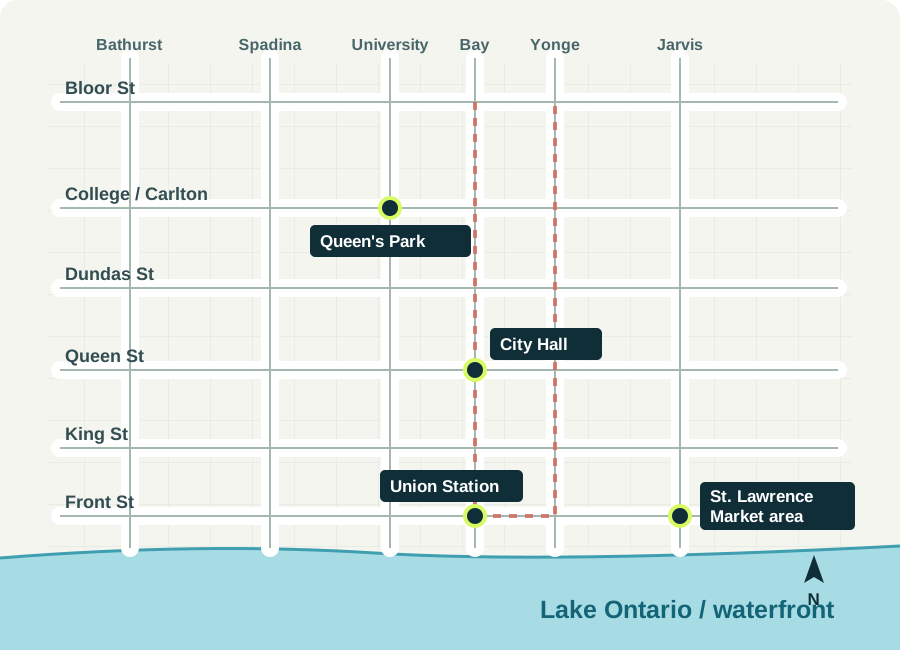
Downtown's TTC connections and walkable blocks can make a nearby session easier to schedule than a trip across the city. A member near Union Station might train before a commute; someone near Queen and Bay could use a lunch window; a resident around College or the waterfront might choose a facility closer to home. These are orientation examples, not advertised meeting points. A trainer may also be able to plan appointments more efficiently when clients and permitted training spaces are concentrated downtown.
Travel is still a real part of the appointment. Discuss the location before committing: Who has access to the room? Is there a change area? What equipment is present? Is the space available at the intended time? How much time will either person spend getting there? A convenient plan accounts for those details instead of saying “downtown” as if every block were interchangeable. Weather, transit delays, construction and accessibility can affect the choice as much as straight-line distance.
Downtown orientation
One compact area, many ways to train.
What a useful first meeting covers
A first meeting can begin with your recent activity, your current walking baseline, the equipment you can use and the time you can reliably protect. The trainer should ask what you want from strength work: feeling more capable in everyday tasks, learning weights, supporting an established walking practice or pursuing a specific training goal. Then you can try a small number of movements, choose suitable variations and record what you did. A good first session does not need to exhaust you to prove its value.
Afterwards, you should know which sessions to do on your own, how many sets and repetitions to attempt, and what would prompt you to hold steady or change the plan. If a movement hurts or symptoms appear, stop and get appropriate individualized advice. A personal trainer is not a substitute for medical care or rehabilitation. The optional Fitness Two4 review can help organize training, but availability, location and terms must be confirmed before enrolment.
Strength alongside 10,000 steps
Weight training joins the Fitness Two4 system; it does not erase the walking and food record. The walking goal is a 10,000-step daily average over the month, built from your actual starting capacity. An ordinary 6,000-step day can be balanced on later days when practical. Heavy lower-body training may make an easy walking day sensible. Split steps across the day, choose a comfortable pace and review the whole month rather than trying to force the highest numbers into every lifting day.
Food accountability remains a short, honest record of meals, snacks and drinks. It helps you see whether the day’s routine supports walking and training. No public weigh-in or body-shame language belongs in that review. A member can share a simple completed-session check-in with the WhatsApp community while keeping detailed loads and any private health information in a personal log.
What to expect over a year
The first month is for a baseline, a training location and a realistic weekly rhythm. The next months are for repeating movements, learning from the log and making small changes when technique and recovery support them. A busy month may call for fewer sessions; that does not wipe away the practice. The three weight training levels are options, not a race. Staying with two sessions that you can repeat may be more valuable than adopting an advanced schedule that disappears after two weeks.
Fitness Two4 membership is a one-time $1,000 CAD payment for a year of the walking, food and community accountability system. The optional once-weekly in-person training and review is subject to scheduling and location terms. Discuss availability and location before making a commitment. Read the membership details before deciding whether the structure fits your life.
Further reading: ACSM resistance training guidance · Public Health Agency of Canada physical activity guidance